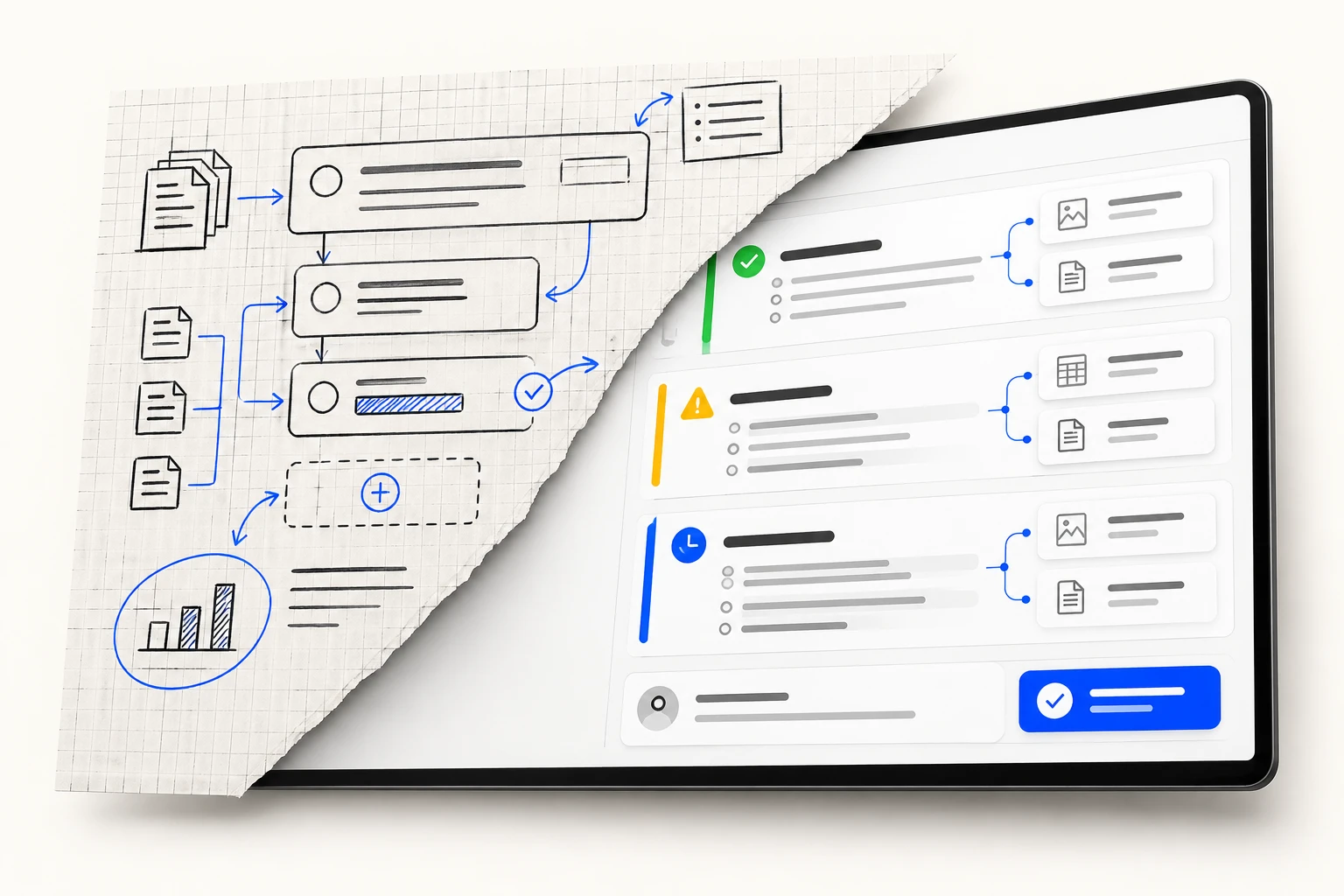
Weekly status. Ground­ed in facts.

For a leader who needs a regular status assembled from several sources, with evidence they can check.

from RUB 250,000 2–4 weeks · one project
Discuss a project-status pilot
From a process sketch to an AI report, with sources, uncertainty and human review
Demonstration · conceptual interfaces, not client work

A draft report. Sources. Human judgment.

What we need

  • One project and an acceptance owner
  • Agreed sources with read permission
  • A reference dataset and success criteria

What you receive

  • An agreed report format with links to source facts
  • Explicit gaps, contradictions and uncertainty
  • A comparison of total preparation time and quality against the current process

Sources are read only. Automatic writes, unreviewed report distribution and expansion to other projects are outside the pilot. Local models and private hosting require a technical assessment.

Demonstration · fictional data

From scattered notes to a status you can verify.

AI prepares a draft. A responsible person checks the sources, sees the gaps and makes the decision.

Source records

Task TASK-42 · 14 October

The module is ready. The security review is still open.

Minutes MEET-07 · 15 October

A release on 18 October is being discussed. No decision yet.

Plan PLAN-03 · 10 October

An older plan lists the release for 16 October.

WEEKLY STATUS 01 / 03

Draft status

The release is not yet confirmed: the security review remains open.

Check TASK-42
Needs clarification

Sources disagree: 16 or 18 October. The date cannot be chosen automatically. MEET-07 / PLAN-03

Manager’s decision: confirm completion of the review, then agree on the release date.

When information is missing

Outdated record

An old date does not become a fact: show its timestamp and seek confirmation.

Unavailable source

State that the source could not be read. Do not claim a complete status.

Insufficient permissions

Respect access restrictions. Flag the gap and contact the access owner.

Start with a task. Verify the result. Decide what comes next.

  1. 01

    Agree on boundaries

    One process, available materials, constraints and a responsible person on your team.

  2. 02

    Define acceptance

    What would be useful and which examples will demonstrate that it works.

  3. 03

    Deliver the chosen stage

    Discovery or a pilot with a clear scope. Scope changes are agreed separately.

  4. 04

    Hand over the result

    Materials, documentation and a decision: develop, change the scenario or stop.

Your team owns the result.

Before starting, we agree on hosting, access, source materials, documentation and handover. Support, response times and work with new sources are scoped separately.

Before we start

Can we go straight to a pilot?

Yes, when the task, materials and criteria are sufficiently clear. Paid discovery is not a mandatory step.

Which systems can be connected?

We confirm sources and connection feasibility for your project before the contract. A system name or logo does not prove a ready integration.

How do we judge the pilot?

Compare preparation, review and corrections on an agreed dataset. Check accuracy, omissions and usefulness; agree on thresholds before starting.

Choose your starting point.

Start with one useful result. The next stage is a separate decision.

Discovery and a pilot purchased separately start at RUB 370,000 in total. Discovery is not mandatory before a pilot; there is no automatic continuation or fee credit.

What needs to work better?

Leave a contact and a few lines about the task. We will discuss fit, materials and the next step during business hours.

info@craftvelox.com

An enquiry is not a purchase. We will respond about the service you selected.

Do not include passwords, clients’ personal data or confidential documents.

Email info@craftvelox.com